

Why Does My Safety Switch Keep Tripping?

Connor Priestman
Licensed Electrican
If your safety switch keeps tripping, it’s detecting electricity leaking from a circuit where it shouldn’t. The most common causes are a faulty appliance, moisture getting into power points or wiring, damaged wiring, and too many appliances running on one circuit.
Safety switch tripping is frustrating, but it means the switch is doing its job. Your safety switch, also called a residual current device (RCD), cuts power as soon as it detects an electrical fault, protecting you and your family from electric shock.
At Voltaic Electrical, our licensed electricians test, install and replace RCD safety switches across Perth. In this guide, we explain why your safety switch trips, how to reset it safely and when it’s time to call an electrician.
What it means when your safety switch has tripped
A safety switch constantly monitors the electrical current flowing through your power circuits and lighting circuits. When everything is working properly, the current flowing out along the active wire matches the current returning along the neutral wire.
If some of that current leaks out, for example through damaged wiring, water or a person touching a live part, the safety switch detects the imbalance and cuts power within milliseconds. That speed is how a safety switch protects you from a serious electric shock.
When a safety switch trips, it flicks to the off position and cuts power to the circuits it protects. If your home has more than one safety switch, you may lose power to some power points or lights while the rest of the house stays on.
Common reasons your safety switch keeps tripping
Most safety switch tripping comes down to a handful of causes. Working out which one applies is the first step to fixing it.
A faulty appliance
A faulty appliance is one of the most common reasons a safety switch trips. Worn cords, damaged plugs or internal faults can cause leaking current, especially in electrical appliances that use water or heat, such as kettles, washing machines, hot water systems, air conditioners and pool pumps. If the switch trips every time you use one particular appliance, that one faulty appliance is the likely cause.
Moisture, heavy rain and storms
Water creates a conductive path for electricity, so moisture is a common cause of tripping after heavy rain. Watch for outdoor power points, garden lighting, pool equipment and any wiring exposed to the weather. Electrical storms and lightning strikes can also cause surges and voltage fluctuations that trip a safety switch, often as a temporary electrical fault that clears once you reset it.
Damaged or faulty wiring
Worn or damaged wiring can let electricity escape and trip the switch, even with nothing plugged in. Wiring inside wall cavities can be damaged by age, pests or renovation work. It needs an electrician to find it, and our electrical fault finding service tracks down where the current is leaking.
Too many appliances on one circuit
Every appliance leaks a tiny amount of current, which is normal. When too many appliances run on the same circuit, often through power boards, that small leakage can add up and trip the safety switch. Overloading a circuit usually trips the circuit breaker instead, so check whether the safety switch has tripped or it’s the circuit breaker.
A faulty or old safety switch
Sometimes the safety switch itself is the problem. Older safety switches can wear out and trip without a real fault, known as nuisance tripping, or fail to trip when they should. If yours is ageing, replacing it, or looking at a switchboard upgrade if the board is old, restores reliable protection.
How to reset a safety switch
Resetting a safety switch only takes a minute. Following these steps also helps you find what’s causing the problem.
- Unplug appliances on the affected circuit. Switch off and unplug everything on the power points that lost power. Leave lights switched off too.
- Find the tripped switch. Open your switchboard (sometimes called a fuse box) and look for a switch in the off position (some sit in a middle position when they trip). Safety switches usually have a test button marked “T”. Make sure your hands are dry, and don’t touch the switchboard if it’s wet, hot or smoking.
- Push the switch to OFF, then back to ON. Simply switching it back on restores power if the fault has cleared.
- Check whether it trips again straight away. If the switch won’t stay on even with everything unplugged, stop resetting it and call a licensed electrician, or an emergency electrician if you’re left without power after hours.
- Reconnect appliances one at a time. Plug each appliance back in and switch it on. If the switch trips when you connect a particular appliance, you’ve likely found the faulty one. Stop using it until it’s been checked or replaced.
When to call a licensed electrician
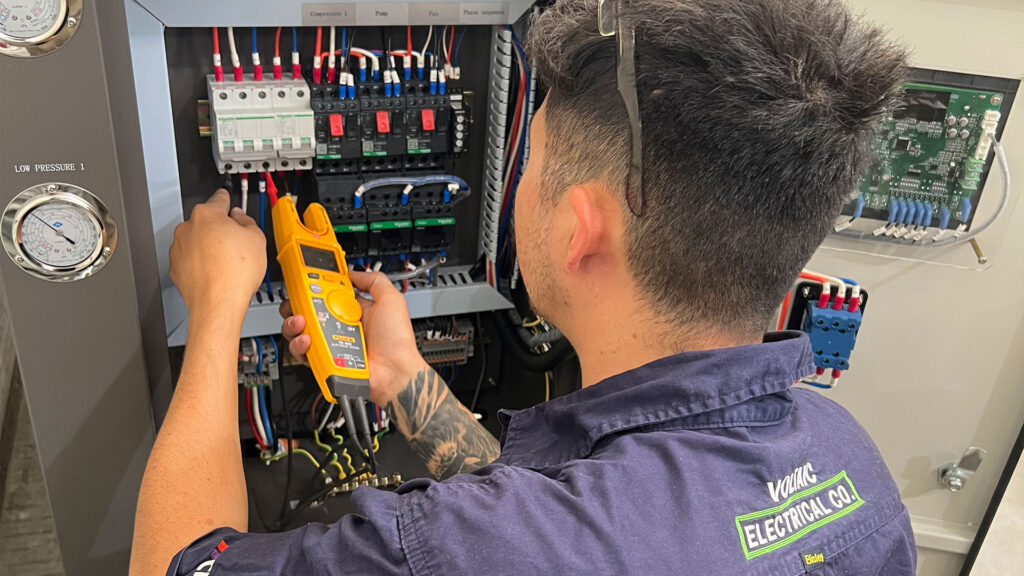
A single trip with an obvious cause is usually nothing to worry about. Call a licensed electrician if:
- It won’t reset or trips with nothing plugged in. This points to faulty wiring or a faulty safety switch, and it needs a qualified electrician to find and fix.
- The safety switch trips repeatedly with no clear pattern. When a switch trips repeatedly and you can’t link it to one appliance, there’s likely an electrical fault somewhere in your electrical system.
- It trips after rain or water exposure. Moisture in outdoor power points, lights or wiring won’t fix itself and can come back with the next downpour.
- You notice burning smells, sparks or a hot switchboard. These are electrical hazards that can lead to fire or serious injury. Keep clear and call an emergency electrician.
- Your home only has one safety switch, or some circuits aren’t protected. A safety inspection shows which circuits are covered and whether you need more safety switches installed.
Never open up wiring or power points yourself to find the fault. In Western Australia, all electrical work must be carried out by a licensed electrician.
Safety switch vs circuit breaker
Your switchboard has both safety switches and circuit breakers, and they do different jobs. Knowing which one has tripped helps you narrow down the cause.
| Safety switch (RCD) | Circuit breaker | |
| Protects | People, from electric shock | Wiring and appliances, from overloaded circuits and short circuits |
| Detects | Current leaking out of a circuit | Too much current flowing through a circuit |
| Common trip causes | Faulty appliances, moisture, damaged wiring | Too many appliances running at once, short circuits |
| How to spot it | Has a test button marked “T” | Usually no test button |
A circuit breaker protects your wiring, but it doesn’t detect current leakage, which is why a safety switch is the only device that protects you from electric shock. Many modern switchboards also use combination devices that do both jobs in one unit.
Testing your safety switch
An electrical safety switch only protects you if it works, so it’s worth testing yours regularly. Building and Energy WA recommends testing every three months.
To test it, press the test button on each safety switch. The switch should flick to the off position straight away. Push it back to ON to restore power. If it doesn’t trip when you press the button, call a licensed electrician to check it.
In Western Australia, homes built after 2000, and any home being sold or rented, must have at least two safety switches. If you’re a landlord or property manager, our real estate and strata electricians can check that your rental properties meet the requirements. Regular testing is one of the simplest electrical safety tips.
Need help with a safety switch that keeps tripping?
If your safety switch keeps tripping and you can’t find the cause, our licensed electricians can track down the fault and fix it safely. Call us on (08) 9444 9170. We’re available 24/7 for urgent safety switch issues across Perth.
Voltaic Electrical is fully licensed and insured (EC 15870), and every job is backed by our lifetime workmanship warranty. As family-owned local electricians, we offer free quotes and transparent pricing on all our electrical services.
For non-urgent work, such as testing or adding safety switches, contact our team to book a time that suits you.
More Resources

How Much Does a Switchboard Upgrade Cost in Perth?
Upgrading your switchboard is essential for safety, reliability, and compliance with modern electrical standards.

EV Charger Installation Requirements for Perth Homes
In this guide, we’ll walk you through meeting EV charger installation requirements and regulations in Perth.

7 Common Signs You Need a Switchboard Replacement
Here are the most common signs it’s time to replace or upgrade your switchboard—especially if you're in Perth and rely on modern appliances or high energy loads.

EV Charger Comparison: How to Compare EV Chargers for Your Home
Understanding EV charging levels Before you compare EV chargers, it helps to understand the different types of EV chargers available in Australia. Level 1 EV Chargers: These plug into a standard power outlet and deliver around 2.4 kW. They're slow, adding roughly 15 km of range per hour. Fine for a small battery or a…

Electrical Safety Tips Every Homeowner Should Know
Most Perth homeowners don't think about their electrical system until something goes wrong. A tripping safety switch, a warm power point, and a slight burning smell from the switchboard. By then, the problem has often been developing for a while. Electrical safety isn't about being overly cautious. It's about understanding the real risks inside your…

Where Should You Install an EV Charger at Home?
Just bought a new electric vehicle (EV) and want the convenience of charging at home? Installing a home EV charger can make everyday EV charging easier, faster and more cost-effective, giving you the ultimate convenience of topping up overnight instead of relying on public charging stations. Before you install an EV charger, one of the…

Get Expert Electrical Help Today!
Need reliable electrical services? We have you covered with professional workmanship, upfront pricing, and Free Quotes.
Why Choose Us?
Why Perth Trusts Us for Their Electrical Needs
We take pride in delivering top-quality electrical services with a commitment to reliability, safety, and customer satisfaction.
Fully Licensed & Insured
Our electricians are fully licensed, insured, and up to date with Australian safety standards, ensuring every job is done safely and correctly.
No Hidden Costs
We believe in transparent pricing, which is why we offer Free Quotes — so you only pay for the work we do, with no surprises.
Lifetime Workmanship Warranty
We stand by the quality of our work. That’s why we offer a lifetime workmanship warranty, giving you peace of mind that the job is done right.
Family-Owned & Operated
As a Perth-based, family-owned business, we take pride in delivering reliable, friendly, and professional service to our local community.
Reliable & On-Time Service
We respect your time. Our electricians arrive as scheduled and complete work efficiently while maintaining the highest standards.
Residential & Commercial
From home electrical upgrades to large-scale business installations, we have the experience and expertise to handle all your electrical needs.
Customer Reviews
What Our Happy Customers Are Saying
Discover why our clients trust us to keep their homes and businesses spotless.


Trusted Brands We Work With


Our Service Areas
Get Expert Electrical Help Today
At Voltaic Electrical, we proudly provide expert electrical services across Perth and surrounding areas. Whether you’re in the heart of the city or the outer suburbs, our team is ready to deliver reliable, high-quality electrical solutions for homes and businesses.
- Perth CBD & Inner Suburbs
- Northern Suburbs
- Southern Suburbs
- Eastern Suburbs & Hills
- Coastal Areas & Surrounding Regions
No matter where you are, we’re committed to providing on-time, professional service with a Free Quote.